


Pigmentation and broken capillaries: why autumn and winter are the time for ELOS and peels

Prices as of 24.10.2026
Types of pigment spots on the face and hands
The type decides whether light helps.
Sun spots
Age spots: flat, well-defined, on the face or hands. Usually respond well to light.
Freckles
Small light-brown dots. Darker in summer, back without sun protection.
Melasma
Blotchy patches on both cheeks. Light can worsen it; the specialist decides.
Post-inflammatory marks
Dark marks after acne or injury. They fade slowly.
When to see a dermatologist first: ABCDE
Before any treatment, a dermatologist should check a spot that changes, grows, bleeds, does not heal or is new in adulthood. Light is not a diagnosis. Melanoma signs (AAD):
- A – asymmetry: the halves do not match
- B – irregular, scalloped or blurred border
- C – several shades
- D – over 6 mm (melanoma can be smaller)
- E – changing size, shape or colour
Couperose vs rosacea: are they the same?
Not quite: couperose also occurs alone.
| Couperose | Rosacea | |
|---|---|---|
| What it is | visible dilated vessels, thread veins | a chronic inflammatory skin condition |
| Signs | persistent redness on cheeks, nose, chin | flushing, bumps, pustules, irritated eyes |
| Causes | sun damage, age, genes | mainly UV; also heat, alcohol, stress |
| ELOS Plus | reduces vessels, usually 1–3 sessions | treats vessels, not the condition |
| Also | the tendency stays; new capillaries can appear | inflammation needs medicines from your GP or a dermatologist |
Why autumn and winter suit light treatment
Untanned skin
Tanned skin absorbs more energy: a higher risk of burns and new spots.
SPF 50 is easier
For at least 7 days after, which is easy in winter.
Finished by spring
1–3 sessions 4–6 weeks apart: an October or November start usually ends before the spring sun.
Peels too
Done all year, but autumn makes the sun rules easier.
After treatment: the spot darkens, then flakes off
Tap a point on the timeline.
First hours
Skin is pink, warm and sensitive, like after mild sun. Gentle moisturiser, no rubbing.
Days 1–3
The spot turns darker. This is expected: the light has broken up the melanin. It is not scratched or picked.
First week
Dark pigment starts to flake off. No sauna, heavy sweating or intensive facials; SPF 50 daily.
1–2 weeks
The spot has mostly flaked off; redness from capillaries fades gradually. Sun protection continues.
1–2 months
The result is assessed and the specialist decides on another session. At least 2 weeks are left before an important event.
Who ELOS suits, and contraindications
Usually suits…
- well-defined sun spots or freckles
- visible facial vessels
- untanned skin
Not done with…
- a recent tan, sunbed or self-tanner
- light-sensitising medicines
- pregnancy or breastfeeding
- inflammation, herpes, a wound in the area
- strong sun allergy
- metal implants in the area, keloid tendency
- fever or acute illness
Side effects and risks
Common
- redness, warmth, mild swelling for hours
- the spot darkens for a while
- several visits, sun rules
Rare
- burns, crusts, bruising
- a herpes flare
- lighter or darker patches for months
- melasma darkening and returning
- very rarely a scar
Tell the clinic
Contact the clinic at once
- blisters
- strong pain
- weeping crusts
- signs of infection
Without delay
In more detail
How ELOS and IPL work
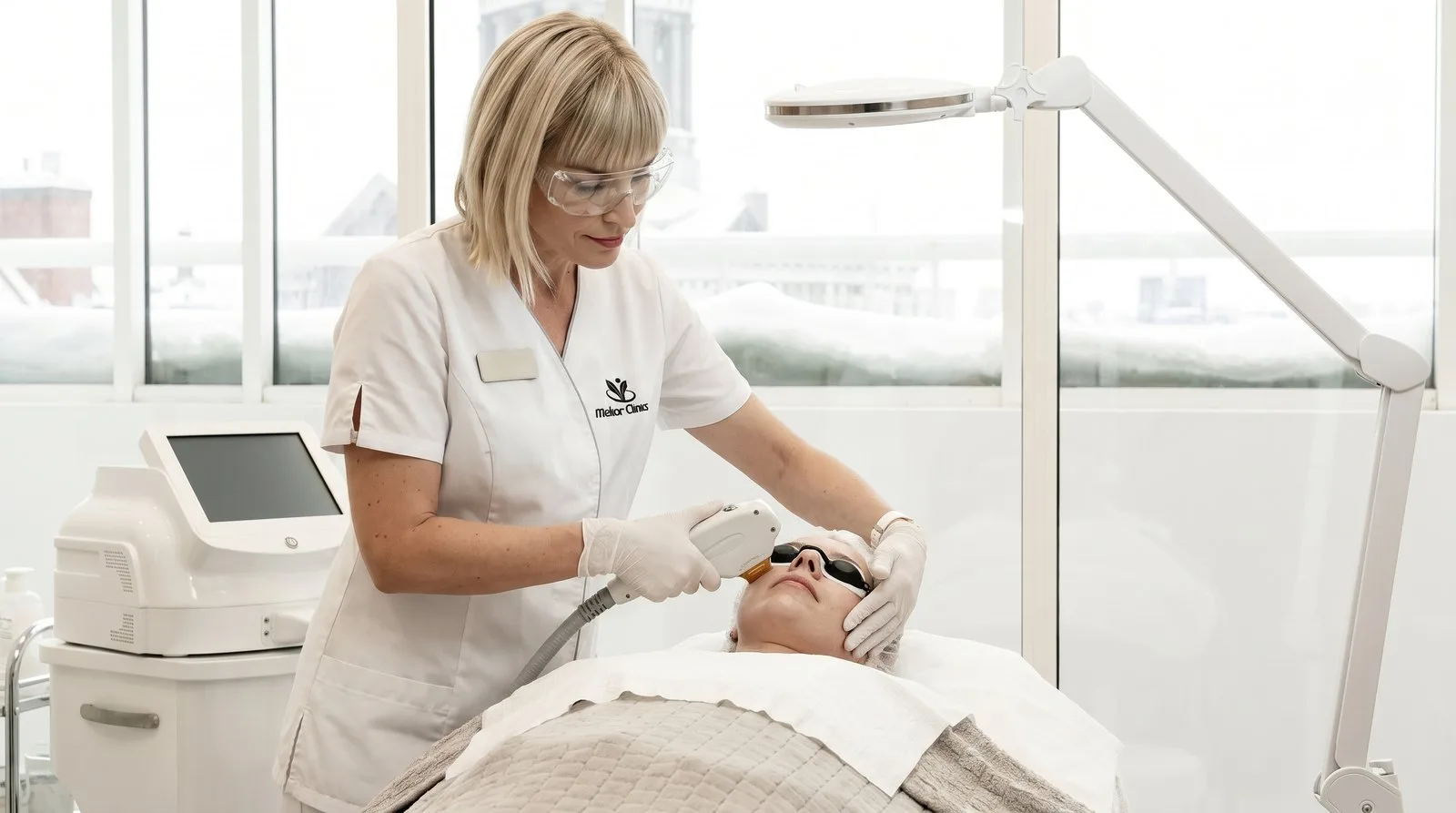
ELOS Plus combines light with bipolar radiofrequency. Melanin in a spot and haemoglobin in a vessel absorb the light and turn it into heat; radiofrequency warms deeper layers, so the light dose can be lower. The spot darkens and flakes off; a dilated capillary closes. Over a larger area the same technology is ELOS Plus photorejuvenation for uneven tone, small spots and fine vessels.
Searches for “IPL for pigmentation” mean intense pulsed light: the same principle, while ELOS adds radiofrequency. A systematic review (Wat et al., 2014) found strong evidence for pulsed light in telangiectasia and moderate evidence in sun spots and rosacea.
Melasma: why light needs caution
Melasma is chronic and returns easily. According to DermNet, UV and visible light both stimulate melanin, and IPL, lasers and microneedling carry a high risk of relapse; chemical peels can also worsen it.
So there is no promise that melasma will clear. If patches are blotchy, on both cheeks and appeared after pregnancy, hormonal contraception or a sunny holiday, the specialist first assesses whether any procedure makes sense. The basis is year-round sun protection.
Sessions and timing
Pigment spots usually need 1–3 sessions 4–6 weeks apart; capillaries also usually 1–3, with the interval set by the specialist. Sessions take about 30 minutes for pigment (up to 60 with preparation), 20–30 for capillaries and 30–40 for photorejuvenation.
The price depends on the treatment and area and is paid per session. More on the ELOS Plus pigment spot removal and ELOS Plus couperose and thread vein pages.
Peels and home care
Acid peels and pigment-focused treatments even out tone more broadly, while ELOS targets single spots and vessels; they are combined at least 3–4 weeks apart. PRX-T33 is 33% trichloroacetic acid with hydrogen peroxide and kojic acid, 4–6 weekly sessions; pHformula M.E.L.A. inhibits tyrosinase, 4–6 sessions 2–4 weeks apart; HH Amber mesotherapy uses niacinamide, glutathione and hyaluronic acid, 3–5 sessions 2–3 weeks apart.
At home: daily SPF 30–50 all year. For melasma, DermNet recommends SPF 50+ with iron oxides. Retinol and acids are paused for a few days around each treatment.
Contraindications: details
Stopping a light-sensitising medicine is discussed only with your own doctor; recent isotretinoin for acne is raised at the consultation. Peels are also not done with allergy to the ingredients, PRX-T33 not with autoimmune disease. On darker skin the risk of pigment changes is higher and settings need extra care.
Frequently asked questions
Does IPL work for pigmentation?
Often, for well-defined sun spots and freckles: the light breaks up the pigment, and the spot darkens and flakes off within 1–2 weeks. With ELOS Plus this usually takes 1–3 sessions 4–6 weeks apart. Melasma is different, because light can make it worse.
Is ELOS the same as IPL?
Similar, but not identical. Both use light that melanin or haemoglobin absorbs and turns into heat. ELOS Plus adds bipolar radiofrequency, which warms deeper layers and allows a lower light dose. The specialist chooses the settings for each spot or vessel.
How are broken capillaries treated?
Visible facial vessels are usually treated with light, for example 1–3 ELOS Plus sessions: the dilated vessel closes and the body clears it. The tendency remains, so new capillaries can appear. If rosacea is behind them, its inflammation is treated with medicines by your GP or a dermatologist.
How much does it cost in Tallinn?
At Melior Clinics, pigment spot removal costs from €75, couperose and thread vein treatment from €35 and photorejuvenation from €220 per session, depending on the area (price list of 24.10.2026).
How long do the results last?
Usually a long time, but not for life. Treated spots flake off, yet sun and hormonal changes can bring new ones, and skin prone to rosacea can form new capillaries. Daily SPF helps keep the result.
Can ELOS treat melasma?
That cannot be promised. Melasma is chronic, light treatments can make it worse, and relapse is common. Whether any procedure makes sense is decided by the specialist; the basis is year-round sun protection and creams discussed with a dermatologist.
ELOS Plus pigment spot removal in Tallinn
Read next
- DermNet: Melasma
- DermNet: Rosacea
- American Academy of Dermatology: What to look for: ABCDEs of melanoma
- Wat H, Wu DC, Rao J, Goldman MP. Application of intense pulsed light in the treatment of dermatologic disease: a systematic review. Dermatol Surg. 2014;40(4):359–377 (PubMed)
This article is general information and does not replace a consultation. Whether a treatment suits you is decided by a specialist at the consultation. Melior Clinics (Star Company OÜ), Liivalaia 53, Tallinn · Estonian Health Board licence L04198.
